How Mountain Biking Improved My Mental Health
DISCLAIMER: This post is for informational purposes only and is not a substitute for professional mental health care or medical advice. Reading this does not create a therapist–client relationship. If you are in crisis or need immediate help, contact 988.
I was really excited to do my first post on Why Mountain Biking Helps Your Mental Health because I genuinely believe it changed my life. But I also wanted to slow down and share more personally about how it’s shaped me — and what I love about it.
In my post on 8 Reasons You Might Struggle with Self-Worth, I talked about how self-worth is built with self-talk, accepting failure, and self-acceptance. For me, mountain biking became a real factory for all of that.
Background
Like many people, I struggle with perfectionism, anxiety, and depression. Growing up, I usually gravitated toward things that came naturally to me. When something took too long or felt too hard, I often gave up quickly. I was active, but I never joined team sports. I liked challenges, but mostly when I could see clear progress and felt fairly certain I’d succeed..
I started mountain biking when I met my now-husband. And honestly? The beginning was rough. I ended rides crying. Frustrated. And often embarrassed.
When we rode together, we often ended the ride frustrated with each other, too. It would have made complete sense for me to stop. But here’s what kept me going: progress was visible. Last week I made it to the bush before I had to hop off my bike. This week I made it to the tree just a little farther up the hill. The wins were tiny, but they were concrete. I could see them, and that made them meaningful.
Every ride showed me something new I could do. And slowly, that began to change how I saw myself.
My First “Death Ride”
About a year into riding, my (now) husband and I went to Tahoe with friends to ride some trails. The first day was great—fun, flowy, but nothing out of the ordinary.
The second day, one friend suggested we ride Mr. Toad’s Wild Ride. If you’re familiar with Tahoe trails, you might already be shaking your head.
It’s long.
It’s technical.
It’s not beginner-friendly.
The loop was about 20 miles with a huge amount of climbing (at elevation). I wasn’t nearly fit enough yet, and the whole thing took about eight hours. By the end, my hands were too tired to use my brakes properly, my legs were toast, and my brain felt like mush. My friend jokingly called it a “death ride,” and somewhere along the way she taught me about “Type 1” and “Type 2” fun.
Type 1 fun = fun while it’s happening.
Type 2 fun = not fun in the moment… but unforgettable and rewarding afterward.
Toad’s was absolutely Type 2 fun.
I don’t remember a single detail from the enjoyable first-day ride, but I remember everything about Toad’s—the tears, the complaining, the moments I wanted to quit, and the pride I felt afterward.
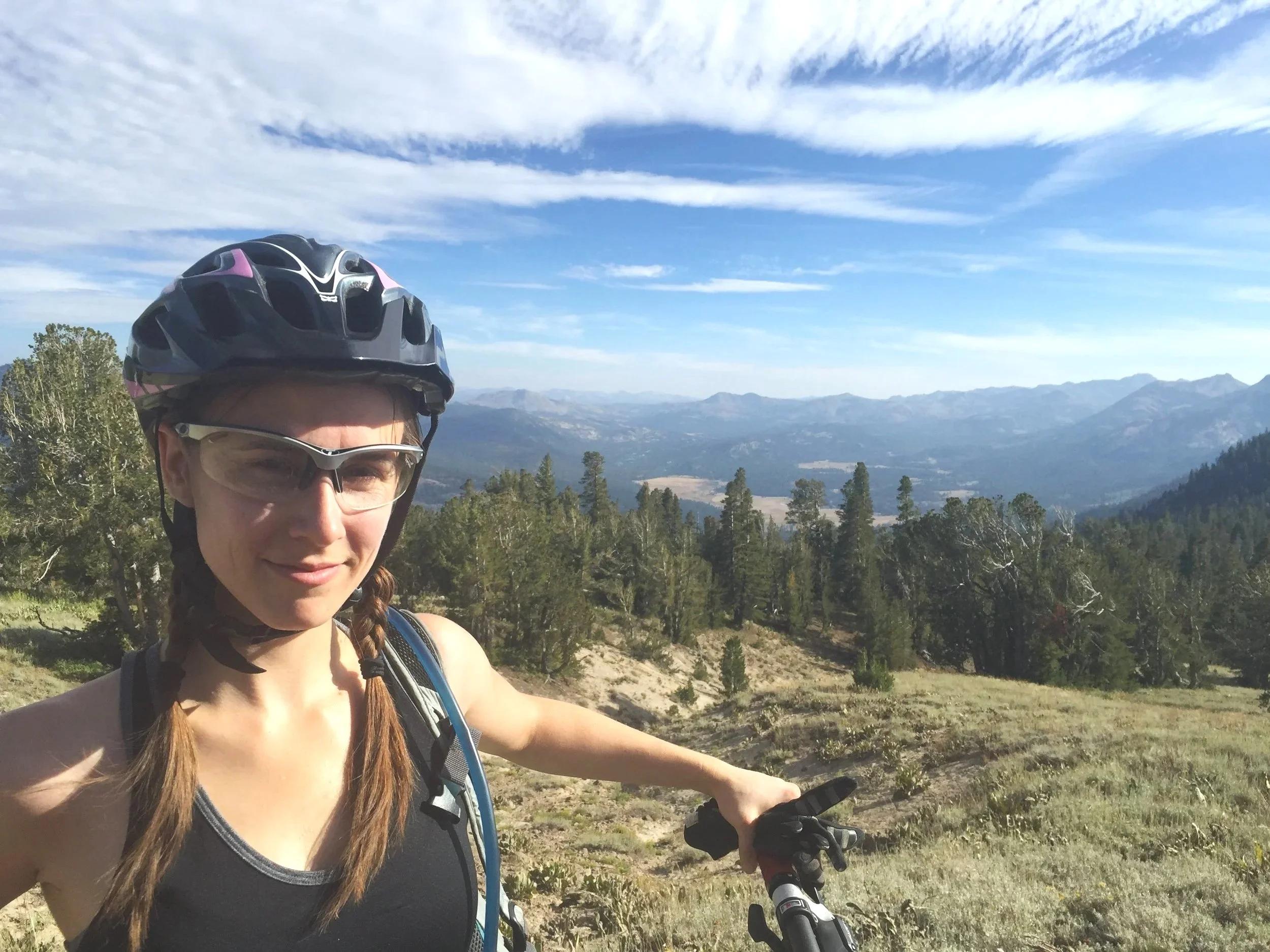
This is me!
This is mid-way up the climb. We weren’t to the top yet, but we were getting close. Just before this photo, I had been crying and wallowing in despair. But I pulled myself together for a picture.
It was gorgeous. And despite how hard it was, I was still moving forward — slowly — with the help of some amazing people.
As my friend said, “If you have enough time and enough snacks, you can get through anything.”
Honestly? That has become one of my favorite life philosophies.
I Did Not Ride Well, But That Didn’t Matter
This experience shows one of the biggest lessons biking has given me: It’s okay to be bad at stuff.
This is still an ongoing lesson for me. And it’s layered. On one level, I don’t want to be bad because of my own high standards. On another level, I don’t want to be bad because I don’t want to be judged. And on yet another level, I don’t want to be bad because I don’t want to inconvenience anyone.
With biking, SO MANY PEOPLE have had to wait for me. But I learned to stop saying, “Sorry I’m so slow,” and instead started saying, “Thank you for waiting.” That shift mattered. And guess what? When I’ve ridden with friends or at social meet-ups, no one has ever made me feel badly for being slower or less skilled. It’s okay to take up space. It’s okay to move at your own pace. It’s okay to have others wait for you. It’s okay to let other people support you.
Some people call this grit—the ability to keep going despite setbacks. For me, it’s also built flexibility and confidence. It changed my thinking. There’s something powerful about knowing you can do hard things — even if you don’t do them particularly well.
That’s a different kind of self-worth.
An Invitation
If you’re thinking about setting a goal to support your mental health, build confidence, or just shake up your routine, I encourage you to try something you’re not great at.
Bonus points if it gets you outside, gets you moving, or connects you with community.
While I’m partial to mountain biking, these benefits can come from so many places — pickleball, a book club, a hiking group, a walking group, amateur geology meet-ups, bird watching, and more.
If you want to set some goals but aren’t sure where to start, check out my prior posts on how to clarify goals, how to set goals that will stick, and how to stop procrastinating and get moving with your goals one you set them.
Growth doesn’t require perfection.
Sometimes it just requires enough time, enough snacks, and a willingness to keep going.
About the Author
Cora Taylor, LMFT, is a licensed therapist in California specializing in therapy for high-achieving adults struggling with anxiety, perfectionism, and burnout. She provides virtual and in-person therapy in Roseville and virtually statewide.
